
For a business, building and maintaining a good reputation is an essential part of success. Attacks on a business’s image can be catastrophic, affecting far more than just the bottom line. These attacks often come in two forms: business defamation and business disparagement. The two are easy to mix up, but they protect different things and have to be proved differently.
Below, we explore both types, noting their differences, a few leading cases, and the elements needed to pursue a lawsuit for each.
Business Defamation
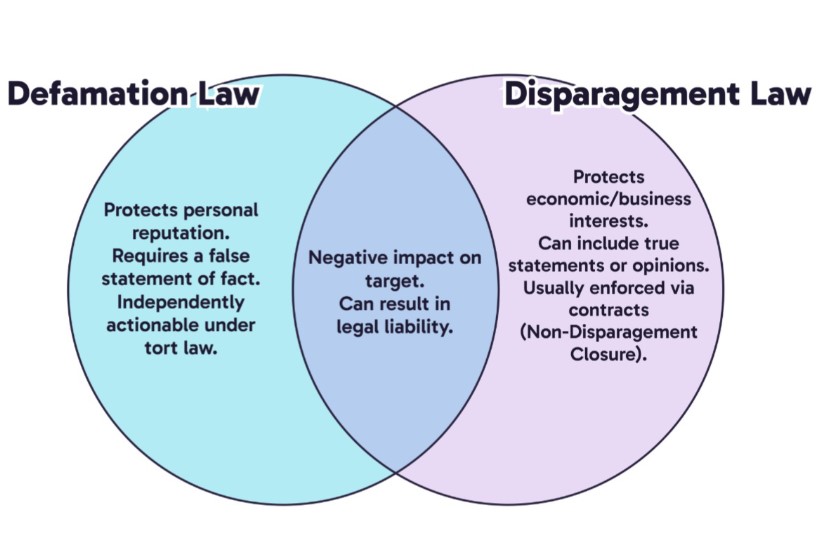
Business defamation is similar to the defamation of an individual. Defamation occurs when someone makes a false statement of fact about a business to a third party, harming the business’s reputation. In other words, it is about what people think of the business. Typical examples are false claims that a company is insolvent, cheats its customers, or has committed fraud.
Business defamation is especially rampant today, with the internet providing numerous ways for people to assault a business’s standing. A disgruntled employee or unhappy customer can inflict severe harm with a few clicks of a mouse. Common instances of business defamation include:
False Social Media Complaints: The ubiquitous nature of social media has enabled individuals to easily post false accusations about how a company treats its customers on platforms like Facebook and X.
Deceptive Online Reviews: Fabricated reviews about a company, its offerings, or services on popular review platforms like Google, Yelp, or TripAdvisor can mislead potential customers and result in real harm.
Misleading Professional Assertions: False information about a business can also surface on professional networking sites such as LinkedIn, impacting the way partners and potential clients perceive the business.
Dishonest Video Content: The power of video-sharing platforms like YouTube can be harnessed to propagate false information about a business, causing significant damage to its reputation.
Business Disparagement
Business disparagement, often referred to as “trade libel” or injurious falsehood, is about money rather than reputation. It covers false statements about a company’s products, services, or property that are made to put people off doing business with it. Because the harm is financial, the business has to show that the statement cost it specific sales or customers. These are called special damages, and they are usually the hardest part of a disparagement claim.
Like with business defamation, the perpetrators of business disparagement can vary, ranging from unscrupulous competitors to disgruntled employees. The rise of the internet has further exacerbated the issue. Some typical examples of business disparagement include:
Malicious Employee Disclosures: Disgruntled employees taking to various online platforms to spread malicious and false information about a company, its practices, or its products.
False Product Quality Claims: Competitors or ill-intentioned parties disseminating advertisements that assert a company’s products are subpar, causing detrimental impact to the company’s brand.
Allegations of Misconduct: Activists or adversaries making baseless claims that a business has violated labor or environmental standards, casting a shadow of doubt over its practices.
Charges of Health Violations: False assertions that a restaurant’s food fails to meet public health standards can have severe consequences, leading to plummeting customer trust and revenue losses.
Do not confuse the tort with non-disparagement clauses. Businesses often put these in contracts with employees, contractors, and customers, and they are enforced through contract law. A clause like that can cover statements that are true or just opinion. The tort of disparagement always requires a falsehood.
Where the Two Overlap
One statement can be both. Say someone falsely claims that a restaurant’s kitchen fails health standards. That hurts the restaurant’s name, and it also sends customers elsewhere, so plaintiffs often plead both claims together. What changes is the proof. For defamation, many courts presume reputational harm when a statement injures a business in its trade. For disparagement, the business has to show actual lost sales with evidence.
Companies need to watch for attacks like these, as they can harm a business in numerous ways, in addition to financial hits. Among the effects of defamation and disparagement are:
- Loss of current and future business.
- Damage to a business’s reputation with partners, advertisers, or sponsors.
- Harm to employee morale.
- Difficulty in retaining staff and hiring new employees.
- Harm to the bottom line: a drop in revenue, business, and/or shareholder value.
How the Courts Have Treated Each Claim
The main defamation cases come from the United States Supreme Court. New York Times Co. v. Sullivan, 376 U.S. 254 (1964), requires a public official to prove actual malice, meaning the speaker knew the statement was false or did not care whether it was true. Gertz v. Robert Welch, Inc., 418 U.S. 323 (1974), bars states from imposing liability without fault on private plaintiffs, which is why most states use a negligence standard for them. Dun & Bradstreet, Inc. v. Greenmoss Builders, Inc., 472 U.S. 749 (1985), involved a construction contractor and a false credit report. A plurality of the Court allowed presumed and punitive damages without proof of actual malice, because the report was a private matter. Milkovich v. Lorain Journal Co., 497 U.S. 1 (1990), held that opinion has no blanket protection, so a negative review can still be actionable if it implies a provably false fact.
Disparagement is mostly state law. In Hurlbut v. Gulf Atlantic Life Insurance Co., 749 S.W.2d 762 (Tex. 1987), the Texas Supreme Court said the plaintiff must show that the defendant published false and disparaging information about its business, with malice and without privilege, and that it caused special damages. Section 623A of the Restatement (Second) of Torts takes a similar approach to injurious falsehood. Bose Corp. v. Consumers Union of United States, Inc., 466 U.S. 485 (1984), is the best known federal case on product disparagement. A speaker maker sued over a published review of its speakers, and the Court held that actual malice had to be shown and that appellate courts must review that finding independently.
What Can Be Done?
Businesses need to monitor the online world as part of their regular reputation management. Many businesses hire social media managers for this purpose, a job now taught in universities. Companies need to keep an eye on popular social media platforms, review sites, video-sharing sites, and search engine results.
When defamation or disparagement occurs, the threat can be lightened and mitigated by a positive and active online presence, but even then, the damage caused can be severe. In such cases, a business can pursue a civil lawsuit to fight back. The goals of such legal actions include removing the false information, mitigating the harm, and recovering monetary damages. To pursue a lawsuit, however, certain elements must be present.
Elements of a Business Defamation Lawsuit
In the context of a defamation lawsuit, the following elements must be demonstrated:
- A false statement of fact was made about the business.
- The false statement was communicated to one or more third parties.
- The speaker was at fault. A private plaintiff generally has to show at least negligence, and a public figure has to show actual malice.
- The false statement harmed the business’s reputation. In many places that harm is presumed if the statement tends to injure the business in its trade.
Defamation does not always hinge on the defendant’s intent to harm. In many states, a failure to use ordinary care (a negligence standard) is enough for a private plaintiff.
Elements of a Business Disparagement Lawsuit
For a disparagement lawsuit, it must be proved that:
- A false statement about the business’s products, services, or property was published.
- The speaker acted with malice, meaning they knew the statement was false or did not care whether it was true, and meant to harm the company’s business.
- The statement was not privileged.
- The false statement caused special damages, meaning specific, provable financial loss.
According to Vince Eisinger, an attorney specializing in business and employment law, “The legal landscape has consistently shown concern for the impact of defamatory and disparaging statements on a business’s reputation. Specifically, in North Carolina, where I practice, reputational harm is presumed when a defamatory statement ‘tends to impeach the plaintiff in the plaintiff’s trade or profession.’”
To successfully bring a lawsuit in such cases, companies need to act fast. This includes disputing the claim, confronting the person who made it, contacting the platform (e.g., X or Instagram), and collecting evidence such as screenshots.
Conclusion
Safeguarding a business’s reputation is of paramount importance in today’s digital era, where misinformation can spread rapidly and inflict lasting damage. By comprehending the distinctions between business defamation and business disparagement, and by being prepared to act with precision and promptness, businesses can fortify their defenses against reputation-related attacks and, when necessary, seek legal redress to protect their image and financial well-being.