

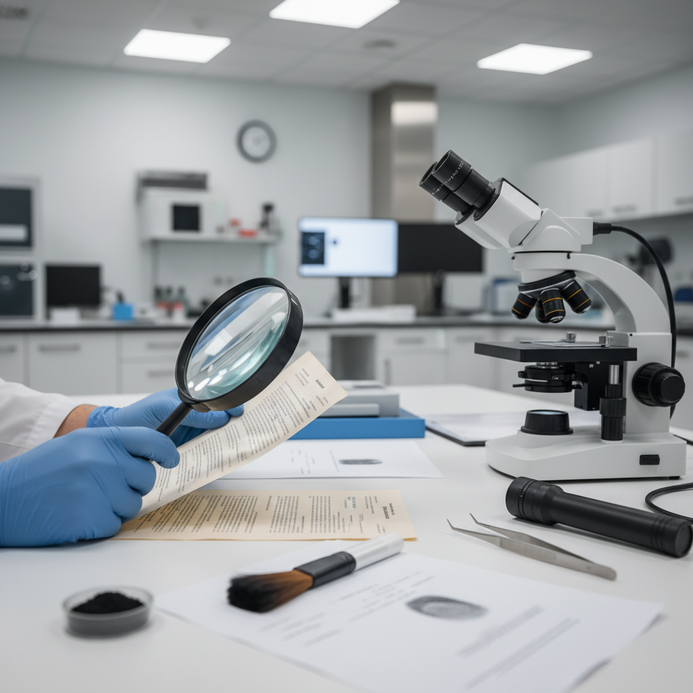
Forensic document examiners are professionals responsible for authenticating and analyzing written and printed materials critical to legal and business disputes. Credentialing, certification, and active association memberships remain primary factors in establishing the trustworthiness and credibility of specialists in this field.
This article details the role of forensic document examiners, their education and training, scientific methods used in casework, and guidance on connecting with certified experts. Capital Expert Services delivers access to highly qualified examiners, supporting attorneys and businesses throughout every phase of the legal process.
Key Takeaways
- Forensic document examiners verify and analyze questioned documents in legal contexts
- Professional certification is crucial; training is extensive and includes advanced scientific methods
- Examiners work on handwriting, document fraud, signature verification, and more
- Modern tools allow examination of both physical and digital documents
- Expert witness testimony by examiners can significantly impact legal outcomes
Understanding the Role of a Forensic Document Examiner
Forensic document examiners use specialized expertise to determine the authenticity and origin of documents. Their conclusions influence investigations and serve as evidence in court, corporate, and private matters.
What does a forensic document examiner do, and how is the profession distinct?
A forensic document examiner applies analytical skills to resolve questions of authenticity, authorship, or alteration involving physical and digital documents. While both forensic document examiners and handwriting experts analyze script, document examiners employ broader scientific methods, examining inks, papers, printing mechanisms, and suspected modifications. Daily responsibilities feature detailed lab assessments, preparation of expert reports, and testimony in court. For more focused insight on handwriting analysis within court cases, consider reading our feature on the role of a forensic handwriting expert and how it complements forensic document examination in legal matters.
When is a forensic document examiner needed, and why hire one?
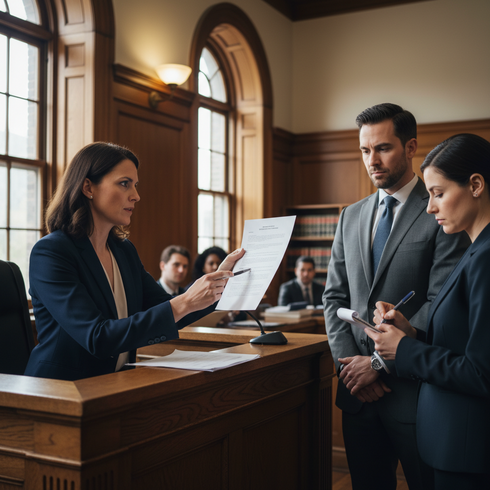
Legal disputes, criminal investigations, and corporate concerns all commonly require an expert in document analysis. Cases involving contested wills, contract disputes, suspected forgeries, or alleged alterations can benefit from expert testimony, which often strengthens a party’s position in litigation by providing clear, scientifically supported findings that courts recognize as high-value evidence.
Popular types of document examination and casework
Document examiners handle diverse assignments spanning various sectors. Their expertise encompasses:
- Analysis of questioned documents such as contracts, wills, and titles
- Handwriting analysis and signature verification to attribute authorship
- Investigating document fraud and forgery, including alterations or counterfeit materials
- Reviewing digital and electronic documents using advanced authentication software and metadata analysis
According to a 2024 National Institute of Justice report, digital document examination tools have rapidly advanced, enabling experts to authenticate electronic records and detect sophisticated manipulations at greater speeds and accuracy levels than before.
Certification, Training Pathways, and Professional Associations
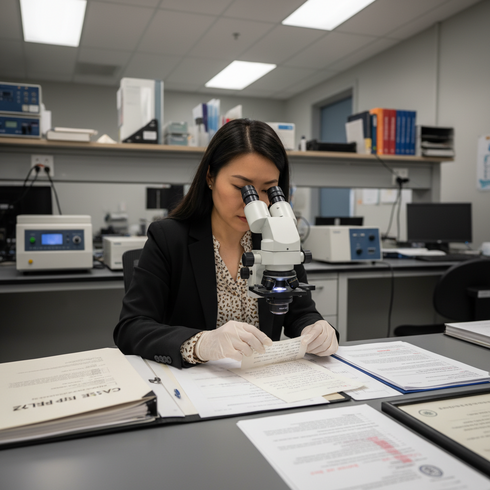
Credibility in forensic document examination relies on formal, continuous education and recognized certifications. Associations and professional resources ensure adherence to industry standards and support examiner development.
What are the steps to becoming a forensic document examiner?
The journey typically begins with a high school diploma, followed by undergraduate education (often in forensic science or a related field). Specialized training through on-the-job apprenticeships or formal graduate programs can last two to four years, creating a cumulative process that commonly spans six to eight years. Experiential learning in established laboratories is crucial for skill development and credibility when entering the field.
Why is certification essential, and what are the main credentials?
Certification signals validated expertise to courts and employers. The Certified Forensic Document Examiner (CFDE) and accreditations from the American Board of Forensic Document Examiners are highly respected credentials, requiring candidates to undergo rigorous testing, demonstrate practical skill, and abide by strict ethical standards. These credentials underscore professional readiness and acceptance in judicial environments.
Which professional organizations and resources are available?
Professional organizations play a significant role in examiner development. The American Society of Questioned Document Examiners (ASQDE) and the American Board of Forensic Document Examiners (ABFDE) offer access to directories, ongoing training, and annual conferences. Recommended resources also include forensic journals, webinars, and laboratory workshops. According to a 2023 International Association for Identification survey, certified examiners reported higher credibility and expanded employment opportunities compared to non-certified peers.
Scientific Methods, Tools, and Case Analysis in Document Examination
Scientific rigor ensures that opinions and conclusions in document examination are objective, reproducible, and accepted in legal settings. New digital technologies have expanded the scope and precision of analytical methods available to practitioners.
What tools and methods are used in modern document analysis?
Modern forensic document examiners leverage a variety of digital and scientific platforms. Essential tools and techniques include microscopes for physical analysis, spectral imaging instruments to reveal alterations, and software like VSC document analysis systems and Adobe Acrobat for digital evidence review. These advances facilitate comprehensive authentication, from signature verification to identifying digital tampering and reconstructing document histories.
Can document examination reveal how and when documents were created?
Examiners sometimes estimate the relative or approximate age of a document using ink dating, paper analysis, and print mechanism assessments. However, techniques have limitations, particularly when precise dating is required. Current technology can identify inconsistencies in ink composition or document formatting but rarely pinpoints an exact date of creation without corroborative evidence or metadata.
Common skills and knowledge areas for examiners (bullet list)
Effective forensic document examiners master a diverse and evolving suite of analytical and technical abilities:
- Evidence analysis and critical thinking, enabling objective conclusion development
- In-depth awareness of document types, printing processes, and substrate properties
- Expertise in handwriting analysis, signature authentication, and fraud detection
- Competency with laboratory instruments and digital platforms, such as VSC analysis systems and Adobe Acrobat
Frequently Asked Questions
How long does it take to become a certified forensic document examiner?
Most professionals spend four years on undergraduate education and an additional two to four years in specialized training or on-the-job apprenticeships, making the pathway typically six to eight years.
Do forensic document examiners only work on handwriting analysis?
No, examiners also analyze other document features such as ink, paper, typewriting, printing processes, and detect alterations or forgeries.
Can a forensic document examiner analyze digital or electronic documents?
Yes, modern examiners employ digital tools to authenticate electronic documents, detect manipulations, and analyze metadata.
What is the difference between a forensic document examiner and a handwriting expert witness?
While all handwriting expert witnesses must be knowledgeable in document analysis, forensic document examiners are uniquely qualified to conduct a broader range of tests and provide expert court testimony. To learn how specialists contribute testimony, see our guide on what it takes to become a handwriting expert witness in legal proceedings.
Where can I find a certified forensic document examiner for my case?
Professional associations and organizations maintain directories of certified experts, and firms like Capital Expert Services can connect clients to the right specialist.
Certified forensic document examiners support legal outcomes by delivering reliable, scientifically grounded opinions. The certification process involves specialized training, professional development through respected associations, and the use of advanced digital tools. Expert document examiners are essential for analyzing questioned documents, providing testimony, and ensuring evidence integrity—services made accessible by Capital Expert Services.